


How to Guarantee Engaging, Memorable Child Activities Despite Tight Schedules?
For over two decades in the family travel and child development space, I've witnessed a common, heartbreaking dilemma among parents: the profound desire to create magical, memorable childhood experiences clashing head-on with the relentless demands of modern life. They yearn for those “picture-perfect” moments, yet often feel overwhelmed by the sheer logistics of planning anything beyond the daily grind.
The problem isn't a lack of love or intention; it's a scarcity of time and, often, a misconception about what truly constitutes “engaging” for a child. Many parents believe that only elaborate outings or long vacations can forge lasting memories, leading to paralysis when faced with a packed calendar. This often results in missed opportunities for connection and a lingering sense of guilt.
But what if I told you that you don't need endless hours or extravagant budgets to cultivate profound engagement and create indelible memories? In this definitive guide, I’ll share battle-tested strategies and expert insights on how to guarantee engaging, memorable child activities despite tight schedules. We'll explore actionable frameworks, real-world examples, and the mindset shifts necessary to transform your family's daily rhythm into a tapestry of joy and discovery.
The Core Challenge: Time Scarcity vs. Childhood Wonder
The modern family schedule is often a dizzying dance of work commitments, school runs, extracurriculars, and household chores. It leaves precious little room for spontaneity, and the idea of “planning” engaging activities can feel like yet another item on an already overwhelming to-do list. Parents often find themselves stuck in a cycle of reactive parenting, addressing immediate needs rather than proactively cultivating moments of wonder.
This isn't just about finding time; it's about shifting our perception of what quality time truly means. We've been conditioned to believe that bigger is better, that a trip to Disney World is inherently more memorable than an afternoon spent building a fort in the living room. However, children often derive immense joy and developmental benefits from simple, present moments. The challenge lies in consistently identifying and seizing these micro-opportunities for connection and learning.
"The greatest gift you can give your children is your present moment. True engagement isn't about the activity itself, but the shared focus and genuine connection it fosters."
As a veteran in family travel, I've observed that the most cherished memories often stem from unexpected moments of shared laughter, discovery, or quiet companionship, not necessarily the meticulously planned grand gestures. The real problem isn't the lack of time, but the lack of a strategic approach to using the time we have effectively and intentionally.

Strategy 1: Embrace Micro-Adventures and Intentional Moments
When time is a luxury, the concept of “micro-adventures” becomes your secret weapon. These are short, impactful, and often spontaneous activities that require minimal planning but deliver maximum engagement. Think of them as concentrated bursts of joy and discovery that fit perfectly into the nooks and crannies of a busy day.
The key here is intentionality. It’s not about filling every spare minute, but about consciously choosing to dedicate even a small slice of time to a child-focused activity, free from distractions. This could be 15 minutes before dinner, during a walk to school, or while waiting for an appointment. The cumulative effect of these small moments is far more powerful than sporadic grand gestures.
The Power of 15 Minutes
You'd be surprised what you can accomplish in just 15 minutes of focused, present interaction. This isn't about adding another chore; it's about reframing existing moments. My experience has shown that consistent, short bursts of engagement are often more effective for children than longer, less focused periods.
- The “Before Dinner” Game: Instead of screens, play a quick board game, do a puzzle, or have a storytelling session while dinner cooks.
- “Walk and Talk” Explorations: Turn a routine walk to school or the store into a scavenger hunt for colors, shapes, or specific natural items.
- “Bedtime Story” Plus: Extend storytime by 5 minutes to discuss the characters, draw a scene from the book, or invent a new ending together.
- “Kitchen Helper” Fun: Involve children in simple kitchen tasks like stirring, washing vegetables, or setting the table, turning it into a collaborative activity.
- “Outdoor Burst” Play: Spend 15 minutes in the backyard or a nearby park – swing, kick a ball, or simply observe nature together.
Case Study: The “Daily Discovery” Family
Meet the Chen family: both parents work demanding full-time jobs, and their two children (ages 6 and 9) have busy school and activity schedules. For years, they felt guilty about not having “enough time.” I suggested they implement a “Daily Discovery” rule: each day, they commit to one 10-15 minute activity with their children. This wasn't planned weeks in advance; it was often spontaneous. One day it was a quick origami lesson, another a “guess the sound” game during their drive, or a science experiment with baking soda and vinegar. Within a month, the parents reported a significant reduction in stress and an unexpected increase in family connection. The children began looking forward to their “discovery time,” and the parents found it remarkably easy to sustain because the commitment was so small, yet the reward was immense. This resulted in a noticeable improvement in the children's mood and a stronger sense of family unity.

Strategy 2: Leverage Location-Based Opportunities and Local Gems
One of the biggest mistakes busy parents make is believing that engaging activities must be destination-driven or require significant travel. In my experience, some of the most memorable moments happen right in your own community, often in places you already visit or pass by regularly. The trick is to view your local environment through a child's eyes – full of potential for exploration and wonder.
This strategy is about maximizing efficiency. Instead of adding an entirely new outing to an already packed schedule, integrate discovery into existing routines. This reduces travel time and logistical overhead, making it far more sustainable for tight schedules.
Pre-Planned Pit Stops & Hidden Treasures
Think about your weekly routines: grocery shopping, errands, commutes. Each of these presents an opportunity. I always advise parents to have a mental “activity bank” for these moments. According to a Forbes article on novelty, introducing new elements, even small ones, can significantly boost engagement and memory. This applies perfectly to transforming mundane tasks into mini-adventures.
- The “Grocery Store Scavenger Hunt”: Give your child a list (pictures for younger kids) of items to find. This turns shopping into an interactive game.
- “Park Bench Story Time”: If you have a few extra minutes after school pickup, stop at a nearby park bench for a quick story or observation game about people passing by.
- “Library Loop” Exploration: If you're near the library, pop in for 10 minutes to grab a new book or explore a different section than usual.
- “Nature's Playground” Detour: Take a slightly different route home that passes a small patch of woods or a community garden. Point out interesting plants, insects, or seasonal changes.
- “Local Landmark Discoveries”: Research a few interesting, quick-to-visit local landmarks (a historical marker, a unique statue, a specific tree) and make a point to visit one each week.
These are not grand excursions, but they are intentional moments of shared discovery that break the monotony of routine and create small, delightful memories. They also foster a sense of belonging and appreciation for your local community.
Strategy 3: The Art of “Activity Stacking” and Multi-Purpose Outings
As an expert in family logistics, I frequently advise parents on “activity stacking” – the brilliant technique of combining a necessary errand or task with an engaging child activity. This is about efficiency and maximizing every precious minute. Why just go to the post office when you can turn it into a lesson on community services, followed by a quick visit to the adjacent playground?
This strategy acknowledges that parents have non-negotiable responsibilities. Instead of seeing these as barriers to family fun, we reframe them as opportunities. It’s about layering purpose and play, ensuring that even the most mundane tasks contribute to a richer family experience.
Combining Errands with Exploration
The beauty of activity stacking is its flexibility. It works for almost any errand or routine task. The key is to think creatively and always have a child's perspective in mind. What might be boring for you could be an adventure for them with a slight shift in approach?
- Post Office & Park Play: Combine mailing letters with a visit to a nearby park or green space for 20 minutes of active play.
- Car Wash & “Sensory Show”: Turn a trip to the automatic car wash into a mesmerizing light and water show for younger children. Discuss the colors and sounds.
- Farmer's Market & Food Discovery: Make grocery shopping at a farmer's market an educational outing. Let children pick out a new fruit or vegetable to try, ask vendors questions, and learn about where food comes from.
- Bank & “Money Talk”: Take children to the bank to deposit coins, explaining the concept of saving and how banks work.
- Pet Store & “Animal Observation”: If you need pet supplies, make a quick detour to observe the fish, hamsters, or other animals. Teach children about animal care and respect.
Table: Activity Stacking Examples
Here's a quick reference for common errands and how they can be stacked with engaging activities:
| Errand/Task | Child Activity Stack |
|---|---|
| Grocery Shopping | Scavenger hunt for ingredients, pick a 'mystery' vegetable to try, count items in the cart |
| Doctor/Dentist Appointment | Bring a new book or small toy, play 'I Spy' in the waiting room, discuss body parts on the way |
| Gas Station Stop | Talk about how cars work, count cars by color, quick stretch/dance break outside |
| Laundry Day | Sorting colors/sizes, folding small items, 'sock puppet' show with clean socks |
| Commute (Car/Public Transport) | Audiobook listening, rhyming games, 'cloud gazing' or observing street art |
Strategy 4: Involve Children in the Planning Process for Ownership and Excitement
One of the most powerful yet often overlooked strategies for guaranteeing engagement, especially with tight schedules, is to involve your children directly in the planning of activities. This isn't just about asking “What do you want to do?” but about a structured, collaborative approach that fosters ownership, boosts excitement, and significantly increases the likelihood of an activity being memorable.
When children have a say, they invest more emotionally. They feel valued, their ideas are respected, and they're more likely to be enthusiastic participants, even if the activity is simple or short-lived. This approach also teaches valuable life skills like decision-making, compromise, and planning.
From Brainstorm to Execution: A Collaborative Approach
I always advocate for child-led play and decision-making where appropriate. As noted by Psychology Today, child-led activities enhance creativity, problem-solving, and self-esteem. Here's how to integrate children into the planning without adding chaos to your tight schedule:
- The “Idea Jar”: Keep a jar where everyone, including children, can write down activity ideas (e.g., “build a fort,” “bake cookies,” “visit the fire station”). When you have a small window of time, pull an idea from the jar.
- “Weekend Brainstorm” (5 minutes): On Friday evening, spend 5 minutes with your children discussing what small, achievable activities they'd like to do over the weekend. Offer 2-3 realistic options based on your schedule.
- “Activity Menu”: Create a simple visual “menu” of quick, pre-approved activities (e.g., “playdough,” “drawing,” “read a book together”). Let children choose from the menu when a gap arises.
- Delegated Planning: For slightly older children, assign them the “activity planner” role for a specific time slot. Give them parameters (e.g., “something we can do in 30 minutes at home”) and let them surprise you.
"Children aren't just passengers on the family journey; they're co-pilots. Empowering them in the planning process transforms passive participation into active engagement and deepens their connection to the experience."
This collaborative approach not only ensures the activities are genuinely appealing to your children but also alleviates the burden of sole planning from your shoulders. It makes the entire family unit responsible for creating memorable moments, fostering a stronger sense of teamwork and shared purpose.
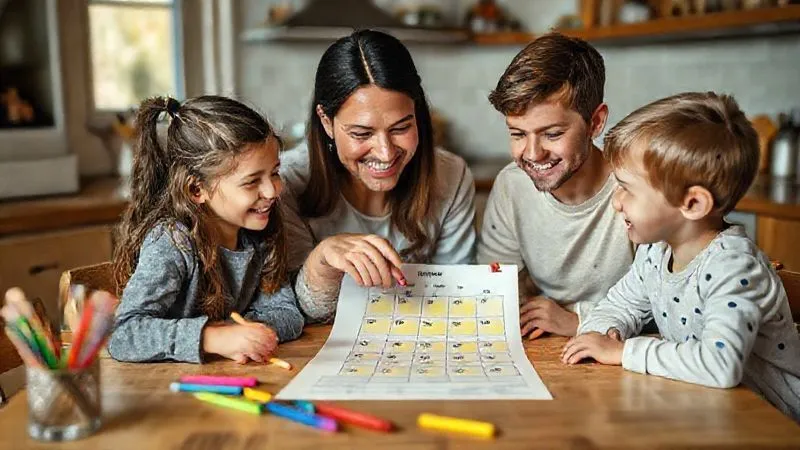
Strategy 5: Master the “Flexible Framework” – Structure, Not Rigidity
Many parents, especially those with tight schedules, shy away from structure, fearing it will stifle spontaneity. However, in my professional experience, a well-designed “flexible framework” is precisely what enables spontaneity and guarantees engaging activities. It’s about having a ready-made toolkit and a general understanding of when and how to deploy it, rather than a rigid itinerary.
This strategy is about proactive preparation that doesn't feel restrictive. It's about creating systems that support joyful, memorable interactions, even when your energy levels are low or unexpected events disrupt your day. It ensures you always have a go-to plan without needing to invent one on the fly.
Building a “Family Activity Bank”
Think of your Family Activity Bank as a reservoir of ideas – categorized by time, location, and necessary materials. This bank is dynamic and grows over time, filled with ideas from your children, online research, or even nostalgic activities from your own childhood. The goal is to eliminate decision fatigue when a small window of opportunity appears.
- Quick & Easy (0-15 min, No Prep): Drawing, building with blocks, telling jokes, a quick game of tag.
- Short & Sweet (15-30 min, Minimal Prep): Baking simple cookies, board games, nature walk in the yard, simple science experiments.
- Out & About (30-60 min, Some Prep): Park visit, library trip, local museum (focus on one exhibit), bike ride.
- Rainy Day Rescues: Indoor scavenger hunt, blanket fort, movie marathon with popcorn, creative writing prompts.
Having this bank means that when a 20-minute gap appears, you don't waste 10 minutes trying to think of something to do. You simply pull from your pre-approved, child-loved list. This proactive approach saves mental energy and ensures that valuable time is spent engaging, not deliberating.
Table: Quick Activity Bank Ideas
Here are some examples to kickstart your own Family Activity Bank:
| Category | Ideas |
|---|---|
| Creative Play (10-20 min) | Finger painting, Play-Doh sculpting, LEGO free build, drawing challenge, making paper airplanes |
| Active Play (10-20 min) | Indoor obstacle course, dance party, backyard soccer/basketball, 'follow the leader' walk, jump rope |
| Quiet/Mindful (10-20 min) | Reading aloud, listening to an audiobook, simple meditation/breathing exercises, 'I Spy' with sounds, nature observation |
| Learning/Discovery (10-20 min) | Simple science experiment (e.g., density with water), counting games, map reading, 'fact of the day' discussion |
| Helper Tasks (10-20 min) | Sorting laundry, watering plants, setting the table creatively, helping prepare a simple snack, organizing toys |
This framework also encourages the creation of family rituals. As Harvard Business Review highlights, rituals provide comfort, meaning, and predictability, which are incredibly beneficial for both children and adults in busy lives. A “Friday night board game” or a “Sunday morning pancake cooking session” becomes a cherished anchor in a bustling week, guaranteeing connection without demanding extensive planning each time.
Overcoming Common Pitfalls: My Expert Advice
Even with the best strategies, parents with tight schedules can fall into common traps that undermine their efforts to create engaging, memorable child activities. I've seen these pitfalls derail countless well-intentioned plans, so let me share some expert advice on how to navigate them.
The Perfection Trap
One of the biggest obstacles is the pursuit of perfection. Parents often feel that an activity isn't “good enough” unless it's Pinterest-worthy or involves elaborate setup. This mindset is a direct enemy of tight schedules. My advice: embrace imperfection and simplicity. A child gains more from 10 minutes of genuine, present play with a parent than from an hour-long, perfectly orchestrated activity where the parent is stressed about execution. Focus on the connection, not the outcome. The mess can be cleaned, but a missed moment cannot be reclaimed.
Screen Time Balance
In our digital age, screens are an ever-present temptation for both children and parents, especially when time is short and energy is low. While screens have their place, relying on them as the default for entertainment can diminish opportunities for true engagement. My recommendation: be intentional about screen-free zones and times. Designate specific times or places (e.g., dinner table, car rides under 30 minutes, 30 minutes before bed) as screen-free. Have your Activity Bank ready for these moments. It's not about prohibition, but about conscious choice and creating space for other forms of engagement.
Remember, your children value your presence and attention above all else. These strategies are not about adding more to your plate, but about re-prioritizing and reframing the time you already have, ensuring it's rich with connection and discovery.

Frequently Asked Questions (FAQ)
Q: My child always wants to do the same thing. How do I introduce new activities without resistance? A: As an expert, I've found that familiarity provides comfort, but novelty sparks curiosity. Start by gently modifying a favorite activity. If they love building blocks, introduce a new challenge like “build the tallest tower that can hold a feather.” Or, present a new activity as a “special secret mission” or a “one-time experiment.” Involving them in selecting from a small, curated list of new ideas (perhaps from your “Idea Jar”) also gives them a sense of control and reduces resistance.
Q: What if I'm genuinely exhausted after work? How can I still be engaging? A: This is a very common and valid feeling. The key is to choose activities that require minimal active input from you but maximize child-led interaction. Think “parallel play” or “guided observation.” For example, lie on the floor while they build around you, offering occasional comments or questions. Or, sit on a park bench and simply watch them play, acknowledging their efforts. Reading aloud is also wonderful, as it allows you to rest while still providing rich engagement. The goal isn't to be a boundless energy source, but a present and appreciative audience.
Q: How do I manage sibling squabbles during these short activities? A: Sibling dynamics can certainly add a layer of complexity. For shorter, focused activities, I often recommend assigning specific roles or tasks to each child to minimize conflict (e.g., “You're the architect, you're the builder”). For cooperative games, emphasize teamwork and celebrate shared successes. If a squabble erupts, acknowledge their feelings quickly, then gently redirect or pause the activity. Sometimes, having separate “micro-adventures” with each child individually for 5-10 minutes can also reduce friction, as it fulfills their need for individual attention.
Q: My child seems easily bored with short activities. How can I sustain their interest? A: Children's attention spans vary, but often “boredom” is a signal for a need for novelty or a different type of challenge. First, ensure the activity is age-appropriate. Second, introduce an element of surprise or a “twist” – a timer, a new rule, or a different material. If they still lose interest quickly, don't force it. Short, intense bursts of engagement are often more effective than dragging out an activity they're no longer enjoying. Be prepared to pivot quickly to another idea from your Activity Bank.
Q: How important is it to document these activities, especially with tight schedules? A: While the primary goal is genuine engagement, documenting can significantly enhance the “memorable” aspect. You don't need elaborate scrapbooks. A quick photo on your phone, a one-sentence note in a journal, or even just a shared conversation about “our favorite thing we did today” before bed can solidify the memory. These small acts of recall reinforce the positive experience and create a shared family narrative, which is incredibly valuable for building lasting bonds.
Key Takeaways and Final Thoughts
Navigating the demands of modern life while striving to create a childhood rich with wonder and connection is a challenge I deeply understand. But as we've explored, the solution to how to guarantee engaging, memorable child activities despite tight schedules doesn't lie in finding more time, but in leveraging the time you have with intention, creativity, and a strategic mindset. The most impactful moments are often the simplest, born from presence and genuine connection.
- Embrace Micro-Adventures: Short, intentional bursts of play and discovery are incredibly powerful.
- Leverage Local Gems: Integrate discovery into your existing routines and local environment.
- Master Activity Stacking: Combine errands with engaging activities for efficiency and fun.
- Involve Your Children: Empower them in the planning process to boost ownership and excitement.
- Build a Flexible Framework: Create an “Activity Bank” to eliminate decision fatigue and enable spontaneity.
Remember, you are the expert on your family. These strategies are tools, not rigid rules. Adapt them, personalize them, and most importantly, approach them with a spirit of playfulness and self-compassion. The goal is not perfection, but consistent, heartfelt presence. By implementing these expert-backed approaches, you'll not only guarantee engaging, memorable child activities but also weave a stronger, more joyful tapestry of family life, one precious moment at a time. Go forth and create those beautiful memories – you've got this!
Recommended Reading
- Best Baking Classes While Traveling Abroad: A Delicious Journey
- Iconic City Attractions Booked? 7 Smart Ways to Salvage Your Trip!
- Unlock Your Best Cruise: How to Master Your Entertainment Schedule
- Minimize Impact: Natural Wonder Tourism - 7 Proven Strategies
- The Ultimate Guide: How to Find Authentic Foodie Destinations Abroad





Your email address will not be published. Required fields are marked *