

How to ensure authenticity of high-end watches bought overseas?
For over two decades in the luxury travel and high-end goods sector, I've witnessed the exhilarating thrill of discovering a rare timepiece abroad – and, regrettably, the crushing disappointment when that dream purchase turns out to be a cleverly crafted fake. It's a scenario that plays out far too often, leaving collectors and enthusiasts not just out of pocket, but deeply disillusioned. The global market for luxury watches, particularly in vibrant overseas hubs, presents both incredible opportunities and significant pitfalls.
The problem isn't just about the financial loss, which can be substantial. It's about the erosion of trust, the feeling of being duped, and the potential damage to one's passion for horology. Modern counterfeits are increasingly sophisticated, capable of fooling even a trained eye at first glance, making the overseas buying landscape a veritable minefield for the unprepared.
That's precisely why I've distilled my years of experience into a definitive framework. This guide will walk you through actionable strategies, drawing on real-world scenarios and expert insights, to equip you with the knowledge and confidence to ensure the authenticity of high-end watches bought overseas. You'll learn not just what to look for, but how to think like a seasoned authenticator, safeguarding your investment and preserving the joy of your acquisition.
The Allure and the Trap: Why Overseas Purchases Entice (And Endanger)
The siren song of an overseas luxury watch deal is often irresistible. Lower prices due to tax differences, favorable exchange rates, or access to models unavailable domestically can make purchasing abroad seem like a savvy move. Many of my clients initially approached me with stories of friends who 'scored' a fantastic deal in Geneva, Dubai, or Hong Kong. However, beneath this enticing surface lies a complex ecosystem riddled with potential dangers, primarily the proliferation of sophisticated counterfeit goods and questionable grey market practices.
Understanding the 'Grey Market'
The 'grey market' refers to the trade of goods through distribution channels that are unofficial, unauthorized, or unintended by the original manufacturer. While not inherently illegal, it operates outside the authorized dealer network. For watches, this means a dealer might acquire stock from an authorized dealer who needs to meet sales quotas, or from a region with lower retail prices, and then sell it in another market. The primary risk here isn't necessarily authenticity (though that's still a concern), but rather the lack of an official warranty, after-sales support, or the potential for 'frankenwatches' – watches assembled from genuine and non-genuine parts.
The Sophistication of Modern Fakes
Gone are the days when a fake Rolex could be spotted by its rattling bracelet or a quartz movement. Today's 'super fakes' are produced with astonishing precision, often using high-quality materials, replicating intricate dial patterns, and even incorporating cloned movements. These counterfeits can be so convincing that they require specialized tools and expert knowledge to differentiate from genuine articles. They specifically target buyers seeking to ensure authenticity of high-end watches bought overseas, exploiting the distance and perceived anonymity.
Pre-Purchase Due Diligence: The Digital Detective Work
Before you even step foot in an overseas boutique or commit to an online purchase, a significant portion of your authenticity verification happens digitally. This isn't just about searching for the best price; it's about building a robust profile of the seller and the watch itself.
Researching the Seller's Reputation
This is your first and most critical line of defense. I always advise clients to perform an exhaustive background check on any overseas vendor, whether it's a physical store or an online platform. Look beyond their own website testimonials.
- Independent Reviews: Scour watch forums, consumer review sites (like Trustpilot, Google Reviews, Yelp), and dedicated watch enthusiast communities. Look for consistent patterns of positive or negative feedback.
- Industry Recognition: Are they members of reputable trade organizations? Do they have a long-standing presence?
- Social Media Presence: A strong, professional, and interactive social media presence can be a good sign, but watch for overly generic or bot-like interactions.
- Red Flags: Be wary of newly established online stores with no history, sellers demanding unusual payment methods (wire transfers only), or those with an excessive number of identical 5-star reviews posted in a short period.
Verifying Documentation and Provenance
A genuine high-end watch should come with a clear history. Ask for high-resolution images of all accompanying documents *before* you travel or finalize a remote purchase.
- Original Box & Papers: This includes the original manufacturer's box, warranty card (stamped and dated by an authorized dealer), instruction manuals, and any chronometer certificates.
- Matching Serial Numbers: Ensure the serial number on the watch matches those on the warranty card and any other certificates.
- Previous Service Records: For pre-owned watches, service records from authorized service centers add immense credibility.
Price Anomaly Detection: Too Good to Be True?
While overseas prices can be lower, there's a limit. If a deal seems extraordinarily good, it almost certainly is. This is a fundamental principle I've seen play out repeatedly in the luxury market. A Rolex Submariner at 50% off retail, even with a favorable exchange rate, is a massive red flag. Reputable dealers operate on thin margins and won't drastically undercut the market.
"In the luxury watch market, an unbelievable deal is often a warning, not an opportunity. Authenticity comes at a price, and legitimate savings are incremental, not revolutionary."
On-Site Inspection: Your Eyes and Hands are Your Best Tools
Once you're face-to-face with the watch, your senses become your most powerful authentication tools. This is where your ability to ensure authenticity of high-end watches bought overseas is truly tested. Take your time, don't feel rushed, and meticulously examine every detail.
Master the Micro-Details: Dial, Hands, and Lume
The dial is the face of the watch, and a high-end timepiece exhibits flawless craftsmanship here.
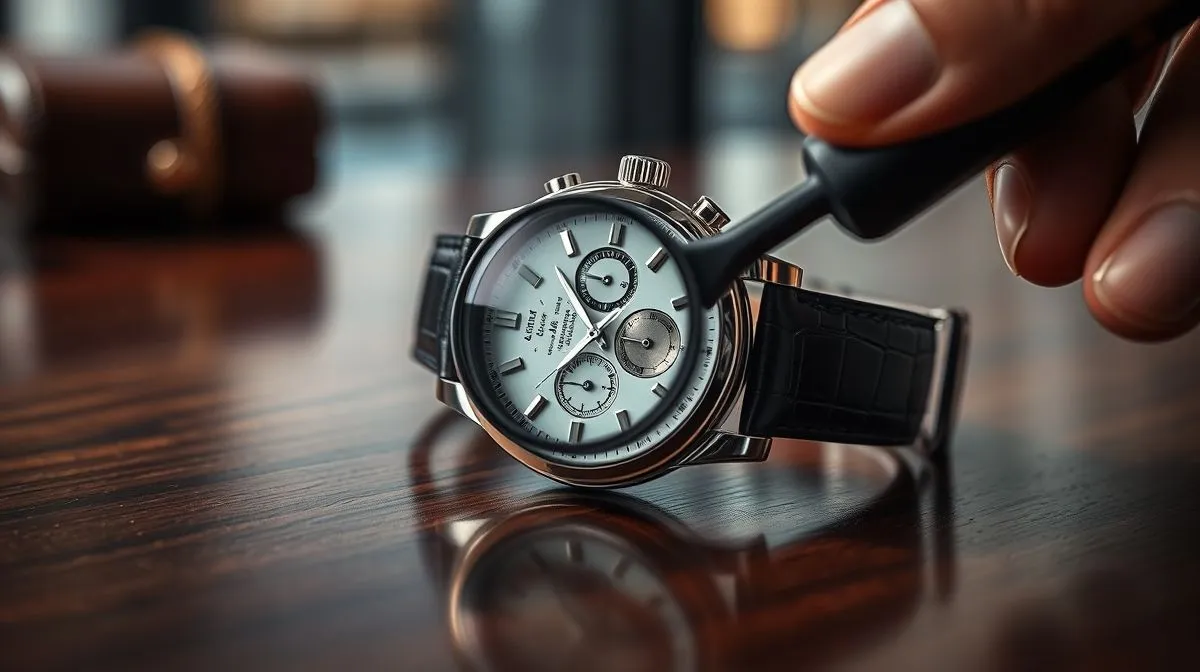
- Print Quality: Examine the printing of the brand name, logos, and minute markers under magnification. It should be crisp, precise, and free of smudges, blurring, or unevenness. Counterfeits often have slightly thicker or uneven print.
- Applied Indices/Markers: If the watch has applied hour markers, they should be perfectly aligned, evenly spaced, and have clean, sharp edges.
- Hands: The hands should be perfectly formed, with sharp edges and a consistent finish. Look for any burrs or imperfections. Many fakes have slightly duller or poorly finished hands.
- Lume: The luminous material (Lume) on the hands and markers should be evenly applied and glow consistently when charged with light. Uneven application or a weak, short-lived glow can indicate a fake.
Case, Crown, and Pushers: The Feel of Quality
The watch case, crown, and pushers (for chronographs) are where the quality of materials and machining truly shine.
- Case Finish: High-end watches feature impeccable finishing – whether polished, brushed, or satin. Transitions between finishes should be sharp and distinct. Look for imperfections, scratches (unless disclosed for pre-owned), or uneven polishing.
- Crown: The crown should operate smoothly, with precise clicks when winding or setting the time. The logo on the crown should be sharply defined and perfectly aligned.
- Pushers: For chronographs, pushers should have a satisfying, crisp action without stickiness or excessive wobble.
Bracelet/Strap and Clasp: Often Overlooked Tells
The bracelet or strap, and especially the clasp, are often areas where fakes fall short.
A genuine luxury watch bracelet will feel solid, weighty, and articulate smoothly. The clasp should close with a satisfying click and show no signs of flimsy construction. Check the engravings on the clasp; they should be sharp and precise, not shallow or uneven.
"The tactile experience of a genuine luxury watch is unmistakable. Pay attention to the weight, the feel of the materials, and the smooth operation of every component. Fakes often betray themselves through a subtle lack of solidity or refinement."
The Movement: Heart of the Matter (Without Opening)
While you typically can't open the case back of a watch during an initial inspection (and you shouldn't ask to unless you're with a trusted watchmaker), you can still infer a lot about the movement's authenticity.
Listen to the Beat: The Sweep of the Second Hand
Most high-end automatic watches have a smooth, sweeping second hand, not a jerky tick-tock like a quartz watch. While some fakes now emulate this sweep, observe it closely. The sweep of a genuine luxury watch is remarkably fluid, often with 6-8 beats per second, making it appear almost continuous. A noticeably stuttering or very obvious stepping motion can be a red flag (unless it's a specific quartz model, which is rare in high-end luxury).
Power Reserve and Accuracy: Initial Checks
If possible, and with the seller's permission, wind the watch fully and note its power reserve. Compare it to the manufacturer's stated power reserve. While you can't test accuracy thoroughly on the spot, ensure the watch starts running immediately upon winding and that the hands move freely without catching.
Case Study: How a Keen Eye Saved 'The Collector' from a Costly Counterfeit
Mr. Chen, a seasoned collector, was eyeing a vintage Patek Philippe during a trip to Tokyo. The deal was attractive, and the seller, a small, unassuming shop, seemed reputable. However, during his on-site inspection, Mr. Chen noticed a minute anomaly: the 'Geneve' stamp on the dial, while seemingly correct, had a microscopically misaligned 'e'. It was so subtle, most would miss it. He compared it to a known authentic example on his phone, confirming the discrepancy. He politely declined the purchase. Later, a horological expert confirmed that this subtle print imperfection was a tell-tale sign of a 'super fake' that had fooled several other buyers. This small detail saved him over $50,000 and the heartache of owning a counterfeit. This case underscores the importance of mastering the micro-details to ensure authenticity of high-end watches bought overseas.
The Paper Trail: Verifying Certificates and Warranties
Beyond the watch itself, the accompanying documentation is paramount for authentication and future resale value. This is where you leverage official channels to confirm what you're holding.
Official Certificates of Authenticity
Many high-end brands issue Certificates of Authenticity (COA) or chronometer certificates (like COSC for Swiss watches). These documents often contain holographic seals, unique serial numbers, and specific security features.
International Warranty Cards
A properly stamped and dated international warranty card from an authorized dealer is crucial. Verify that the dealer's stamp and date are legible and correspond to the brand's network. Some brands, like Rolex, have specific warranty card formats that evolve over time; familiarize yourself with the correct version for the watch's era.
Sales Receipts and Customs Declarations
Always insist on a detailed sales receipt. This should include the seller's full details, the watch's specific model and serial number, the purchase date, and the price paid. For overseas purchases, a proper customs declaration is also vital, as it confirms the watch was legally imported and helps avoid future issues with authorities or when returning to your home country. According to a study by the FTC on product claims, transparency in origin and documentation is key for consumer trust.
Many brands offer online portals or customer service lines where you can verify serial numbers against their production databases. For example, Omega has a robust service for checking the authenticity of timepieces. Always utilize these resources. Visit the official brand website (e.g., Rolex.com or Omegawatches.com) to understand their specific authentication procedures and to find authorized service centers.
Post-Purchase Safeguards: Expert Verification and Appraisal
Even after a thorough personal inspection and document verification, the ultimate peace of mind comes from an independent, expert assessment once you've returned home.
Independent Watchmaker Appraisal
Upon your return, immediately take your watch to a highly reputable, independent watchmaker or a certified appraiser. Ideally, choose one who specializes in the specific brand of your watch but is not affiliated with the seller. They will perform a thorough examination, often involving opening the case back (with your permission) to inspect the movement. This is the definitive way to ensure authenticity of high-end watches bought overseas.
- Movement Inspection: They will check the movement's authenticity, serial numbers (which often appear on the movement itself), finishing, and proper operation.
- Material Verification: They can verify the precious metals, diamonds, or other materials used against official specifications.
- Condition Report: They will provide a detailed condition report, which is vital for insurance purposes.
Authentication Services
Several professional authentication services specialize in luxury watches. These services often employ advanced techniques and databases to verify authenticity, sometimes even without opening the case. While this might incur an additional cost, it's a small price to pay for absolute certainty, especially for a significant investment. As renowned horology expert and author, Gisbert L. Brunner, frequently emphasizes, "The true value of a watch lies not just in its materials, but in its verified provenance and mechanical integrity."
Navigating Returns and Disputes for Overseas Buys
Despite your best efforts, sometimes things go wrong. Knowing your options for returns and disputes is crucial, though significantly more challenging with overseas purchases.
"The legal landscape for international consumer disputes is complex. Always assume that recourse will be difficult, time-consuming, and potentially expensive if you have to pursue it across borders."
Before purchasing, clarify the seller's return policy, especially for international buyers. Understand if there are restocking fees, and who covers shipping and customs duties for returns. Pay with a credit card that offers buyer protection, as this can be your strongest ally in the event of a dispute. Many credit card companies offer chargeback options for fraudulent transactions. While not a guarantee, it provides a layer of security. Research consumer protection laws in the seller's country, though enforcing them from abroad can be challenging. Resources like the European Consumer Centre Network or similar regional bodies can sometimes offer guidance for cross-border issues.
Frequently Asked Questions (FAQ)
Question? Can I trust a dealer just because they have a physical store overseas?
Answer: Not entirely. While a physical presence can offer a sense of legitimacy, it doesn't guarantee authenticity. There have been instances of 'brick-and-mortar' stores selling counterfeits, often mixed in with genuine pieces. Always combine physical presence with thorough online reputation checks, meticulous on-site inspection, and a clear understanding of their return policies. A physical store simply means you have a location, not necessarily a reputable business.
Question? What if the watch comes with a "customs declaration" saying it's a gift to avoid taxes?
Answer: This is a massive red flag and a highly illegal practice. Declaring a high-value item as a 'gift' or under-declaring its value to avoid customs duties is tax evasion. If caught, you could face significant fines, confiscation of the watch, or even legal action in your home country. A reputable seller would never suggest this. It often indicates a seller who is willing to cut corners, which extends to the authenticity of their products. Always insist on proper documentation and declare the full, accurate value.
Question? Are there any specific red flags for particular brands (e.g., Rolex, Patek)?
Answer: Yes. For Rolex, common tells on fakes include uneven cyclops magnification (the date magnifier), incorrect coronet logo details, and a non-smooth sweep of the seconds hand. For Patek Philippe, the level of finishing on the movement (even if not visible) is a major differentiator; fakes simply cannot replicate the hand-finishing and intricate details of a genuine Patek movement. Generally, for any brand, be wary of mismatched serial numbers, poor lume, and incorrect fonts or spellings on the dial or case back. Familiarize yourself with the specific nuances of the brand and model you are interested in. Resources like Hodinkee or WatchPro provide in-depth brand-specific information.
Question? Should I always go through an authorized dealer? What about grey market?
Answer: For absolute peace of mind, an authorized dealer (AD) is always the safest bet. You get a direct manufacturer's warranty, guaranteed authenticity, and proper after-sales service. The grey market can offer price advantages, but it comes with increased risk. If you choose the grey market, ensure the dealer has an impeccable, long-standing reputation, transparent sourcing, and provides original box and papers. Understand that manufacturer warranties might not be honored if purchased outside the official AD network. It's a calculated risk that requires extensive due diligence.
Question? What's the role of blockchain or NFTs in watch authenticity?
Answer: Blockchain and NFTs are emerging technologies that offer promising solutions for immutable digital certificates of authenticity. Some luxury brands (like Vacheron Constantin and Breitling) are experimenting with issuing digital certificates for their watches on a blockchain, linking a unique NFT to each timepiece's serial number. This creates a tamper-proof record of ownership and authenticity. While not yet widespread, this technology has the potential to revolutionize how we verify luxury goods and make it significantly easier to ensure authenticity of high-end watches bought overseas in the future. Always check if the brand you're interested in offers such a service.
Recommended Reading
- Is a Luxury All-Inclusive Beach Resort Truly Worth the Price? The Ultimate Guide
- Unlock Green Wisdom: How to Gain Sustainability Learning from Eco-Trips
- Unlock the Secrets: How to Plan a Safe Solo Long-Distance Hiking Trip
- Unlock Eco-Travel: What Gear Is Essential for Sustainable Adventure Travel?
- Master Winter Sports Safety: Your Guide to Preventing Common Injuries
Key Takeaways and Final Thoughts
- Do Your Homework: Thoroughly research the seller's reputation and the specific watch model before committing.
- Master the Details: Learn to identify the subtle nuances of genuine craftsmanship that fakes often miss.
- Demand Documentation: Insist on original box, papers, and a legitimate sales receipt. Verify serial numbers.
- Trust Your Gut: If a deal seems too good to be true, it almost certainly is.
- Get Independent Verification: Always have your overseas purchase appraised by a trusted, independent watchmaker upon your return home.
The world of luxury watches is a journey of passion and precision. While the allure of an overseas purchase can be strong, the true value of your acquisition lies in its authenticity. By approaching every potential buy with a blend of meticulous research, keen observation, and strategic post-purchase verification, you can confidently navigate the international market. Safeguard your investment, protect your passion, and enjoy the timeless beauty of a truly authentic high-end timepiece, no matter where in the world you acquire it.


Your email address will not be published. Required fields are marked *