

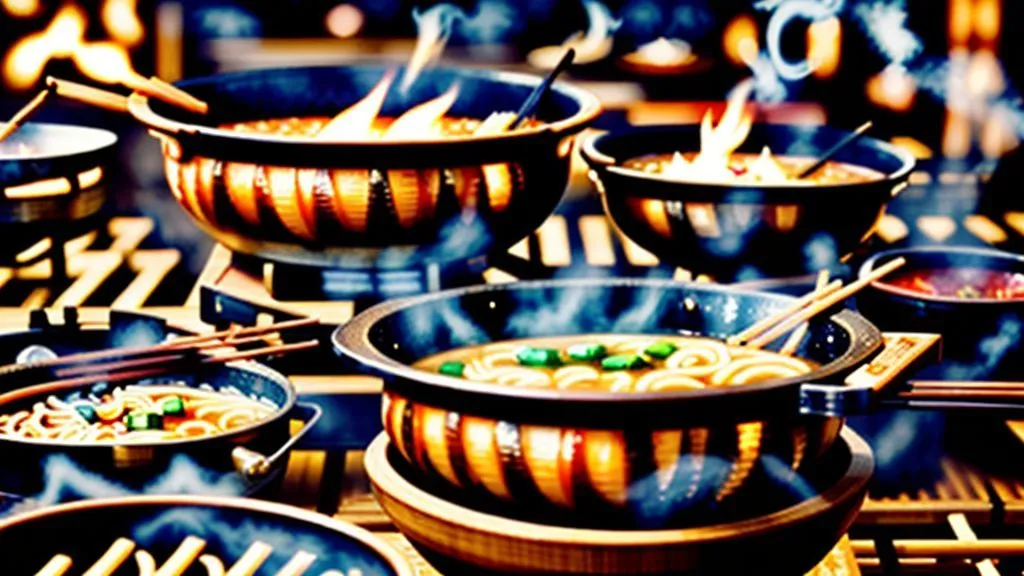
How to Visually Elevate Challenging Street Food for Travel Publications?
For over 15 years, traversing bustling markets and quiet alleyways in search of the next culinary story, I've encountered countless dishes that taste like heaven but look, shall we say, less than photogenic. I vividly recall a particular bowl of 'Mohinga' in Myanmar – a rich, comforting fish noodle soup. Its complex flavors were intoxicating, yet its muddy brown hue and dense composition made it a nightmare to photograph in the dim light of a street stall. This isn't just a personal anecdote; it's a universal challenge for anyone trying to capture the soul of street food.
The problem isn't the food itself; it's often the environment, the inherent 'ugliness' of certain traditional preparations, or the sheer chaos that surrounds it. Photographers often feel caught between the desire to showcase authenticity and the need to produce visually appealing content for demanding travel publications. This struggle can lead to either generic, uninspired shots or, worse, completely overlooking dishes that are culturally significant and incredibly delicious, simply because they don't 'pop' on camera.
But what if I told you that these 'challenging' dishes are actually your greatest opportunity? In this definitive guide, I'm going to share my battle-tested strategies to transform even the most visually uncooperative street food into captivating, drool-worthy images that demand attention. We'll delve into technical prowess, creative composition, ethical considerations, and storytelling techniques that will not only elevate your food photography but also enrich your travel narratives for any publication.
Understanding the 'Ugly Delicious' Phenomenon: Beyond Surface Aesthetics
Before we can elevate, we must understand. The term 'ugly delicious,' popularized by chefs and food critics, perfectly encapsulates many street food experiences. These are dishes where flavor, texture, and cultural significance far outweigh their conventional visual appeal. Think of a rich, dark mole, a bubbling stew, or a messy, overflowing sandwich – dishes that are often monochromatic, shapeless, or simply chaotic.
The Core Challenge: Authenticity vs. Appeal
The tension lies in preserving the authenticity of these dishes while making them appealing to a broad audience. Travel publications thrive on images that transport the viewer, evoke emotion, and spark wanderlust. A muddy-looking dish, no matter how delicious, can fail to do this without a thoughtful approach.
In my experience, the most impactful street food photography doesn't just show the food; it reveals its story, its heritage, and its place within a culture. This means looking past superficial aesthetics to find the deeper visual cues.
Examples of challenging foods include:
- Dark, saucy stews (e.g., Filipino Dinuguan, Hungarian Goulash)
- Viscous, monochromatic soups (e.g., Vietnamese Bún Riêu, certain lentil dahl preparations)
- Irregularly shaped or 'messy' dishes (e.g., Indian Chaat, certain types of tacos)
- Dishes with unusual textures or colors (e.g., Balut, black puddings)
Mastering the Light: Your Most Powerful Ally
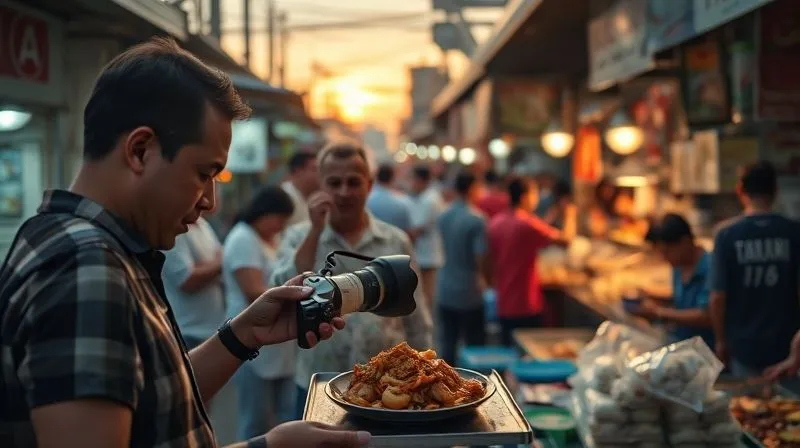
Light is the painter's brush and the photographer's magic wand. On the street, you rarely have control over your environment, but you can learn to master the available light and even introduce your own subtle enhancements.
Natural Light: The Golden Hour Advantage
The golden hour (shortly after sunrise or before sunset) provides soft, warm, directional light that is incredibly flattering. However, street food often operates outside these ideal times, under harsh midday sun or dimly lit night stalls.
- Seek Shade: If the sun is too harsh, look for natural shade from buildings, trees, or awnings. This diffuses the light, reducing harsh shadows and hot spots.
- Backlight for Drama: Position your dish with the light source behind it. This creates a beautiful rim light, highlighting steam, textures, and giving a sense of depth. Use a reflector to bounce light back into the shadows.
- Window Light: If a stall has an open window, this can act as a large, soft light source, similar to studio lighting.
Artificial Light: When Nature Fails You
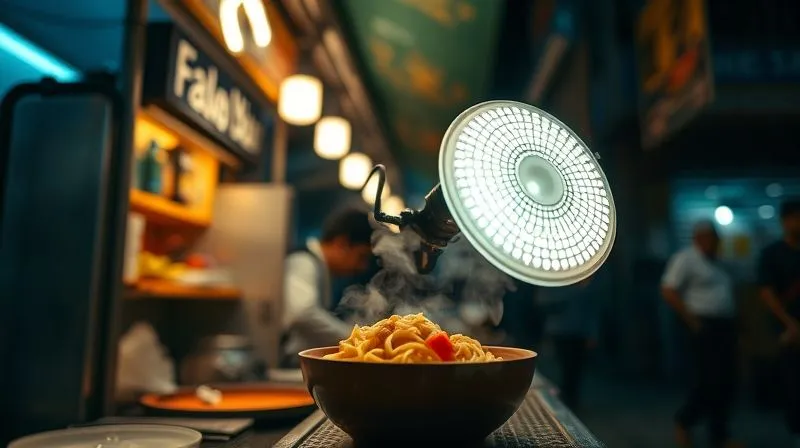
Sometimes, natural light simply isn't an option. This is where a small, portable lighting kit becomes indispensable. I'm not talking about huge strobes, but compact LED panels.
- Portable LED Panels: Invest in a small, battery-powered LED panel with adjustable color temperature. These are lightweight and can easily fit into your camera bag.
- Softbox or Diffusion: Always use a small softbox or a piece of diffusion material (like a white shower cap or a small sheet of tracing paper) over your LED light. This softens the light, preventing harsh shadows.
- Angle and Distance: Position the light slightly to the side and above your dish, mimicking natural light. Experiment with distance; closer light is softer but can create hot spots, while farther light is harder but more even.
- Subtle Fill: Use a small reflector (even a piece of white cardstock) opposite your light source to fill in shadows and add dimension.
The goal with artificial light on the street is to enhance, not to overpower or make it look unnatural. Subtlety is key to maintaining authenticity.
Compositional Genius: Framing the Narrative
Composition is how you arrange elements within your frame to tell a story and guide the viewer's eye. For challenging street food, it's about finding order in chaos and emphasizing the appealing aspects.
Rule of Thirds and Leading Lines
These fundamental compositional rules are your best friends. Placing your main subject off-center (at the intersections of the rule of thirds grid) creates a more dynamic image. Leading lines (like the edge of a table, a row of ingredients, or even a spoon) can draw the viewer's eye directly to your dish.
- Off-Center Placement: Don't always put the dish dead center. Experiment with placing it in one of the 'power points' of the rule of thirds grid.
- Natural Leading Lines: Look for elements in the environment that can naturally lead the eye towards your food, such as a vendor's arm reaching for an ingredient or the line of the serving counter.
Depth of Field: Isolating Your Subject
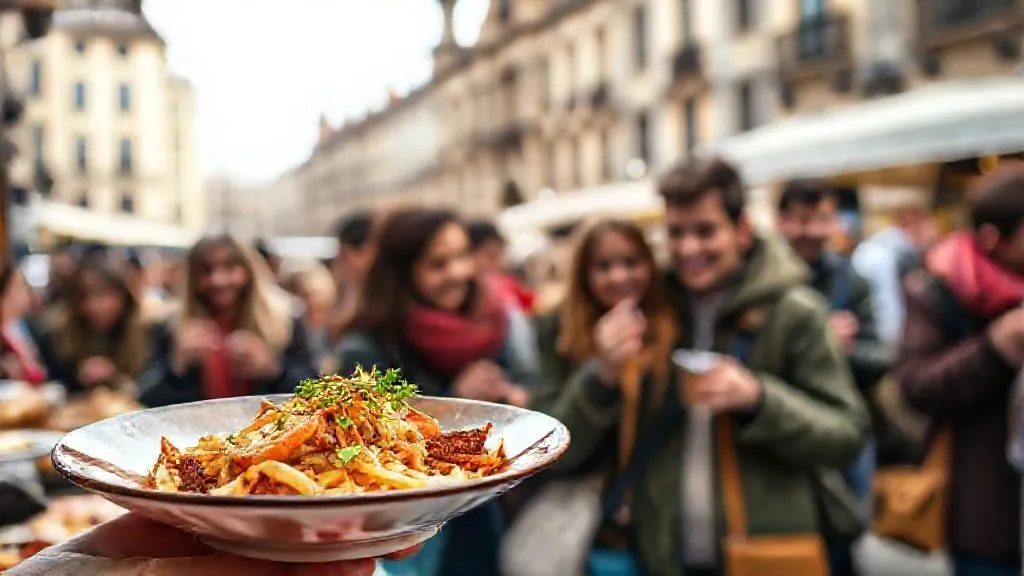
In a busy street environment, a shallow depth of field (a blurred background) is invaluable. It isolates your dish, making it the undeniable star of the show, and minimizes distractions from the often-cluttered surroundings.
- Use a Wide Aperture: Shoot with a low f-number (e.g., f/1.8, f/2.8) on your lens.
- Get Closer: The closer you are to your subject, and the farther your subject is from the background, the more pronounced the bokeh (background blur) will be.
- Focus Precisely: Ensure your focus point is razor-sharp on the most important part of the dish – perhaps a garnish, a glistening sauce, or a key ingredient.
The Power of Negative Space
Sometimes, less is more. Negative space (the empty area around your subject) can help a challenging dish breathe and stand out. It gives the eye a place to rest and emphasizes the form and texture of the food itself.
Case Study: Elevating 'Gado-Gado' Through Smart Composition
Maria, a travel photographer in Jakarta, struggled with the visual appeal of Gado-Gado, a traditional Indonesian salad that often appears less vibrant than it tastes, typically a mix of green vegetables, potato, hard-boiled egg, and a thick, brown peanut sauce. By applying the rule of thirds, positioning the colorful vegetables and egg at a power point, using a shallow depth of field to blur the busy market background, and focusing on the intricate textures of the peanut sauce, she transformed what was once a visually challenging dish into a compelling story of freshness and authentic flavor. Her image, published in 'Southeast Asian Culinary Journeys,' garnered significant engagement, proving that careful composition can make even the 'ugliest' dishes shine by highlighting their inherent beauty and context.
Here's a quick compositional checklist I use:
| Compositional Element | Action | Benefit |
|---|---|---|
| Rule of Thirds | Place key elements off-center | Dynamic and engaging image |
| Leading Lines | Guide viewer's eye to the dish | Clear focal point, visual flow |
| Depth of Field | Isolate subject with shallow focus | Eliminates distractions, emphasizes food |
| Negative Space | Allow breathing room around subject | Highlights subject, creates clean aesthetic |
| Framing | Use natural elements to frame the dish | Adds context, draws attention |
Styling for the Street: Authenticity Over Artifice
Traditional food styling often involves tweezers, sprays, and meticulous arrangements. On the street, this approach is not only impractical but also counterproductive. The key is 'un-styling' – making subtle adjustments that enhance authenticity without making the food look artificial.
The Art of 'Un-Styling'
Your goal is to make the food look its best, naturally. This means embracing the imperfections that give street food its character.
- Embrace the Mess: A little sauce splatter, a crumb, or a slightly uneven edge can convey authenticity and tell a story of a freshly prepared, well-loved dish.
- Highlight Texture: For saucy or monochromatic dishes, look for opportunities to show texture. Stir the sauce slightly to reveal layers, or angle the dish to catch light on its surface.
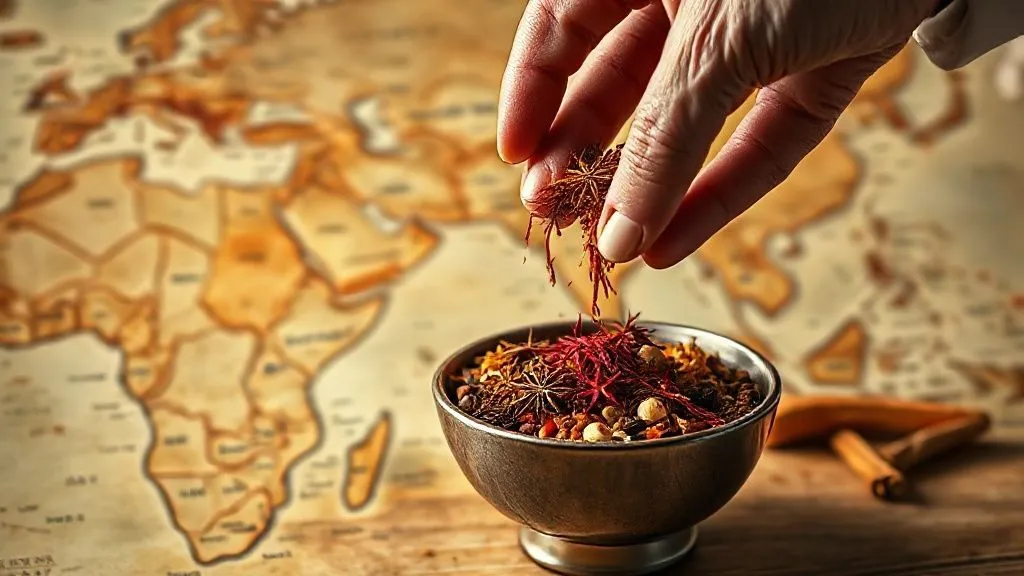
- Add Fresh Garnish: If available, a sprinkle of fresh herbs, a squeeze of lime, or a chili flake can add a pop of color and freshness. Always use what's naturally available at the stall.
Props and Backgrounds: Context is King
The environment is your prop closet. Use it wisely to add context and visual interest without overwhelming the dish.
- Natural Backgrounds: The vendor's hands, the colorful array of ingredients on the stall, the texture of a wooden table, or even the bustling crowd can provide an authentic backdrop.
- Subtle Props: A traditional spoon, a local beverage in a characteristic cup, or a piece of relevant street art in the background can enhance the narrative.
- Cleanliness Matters: While embracing authenticity, ensure the immediate area around your dish is clean enough to be appealing. Wipe away obvious spills or distracting debris.
Remember, you're not staging a studio shoot; you're documenting a moment. The best 'styling' on the street is often about thoughtful observation and subtle enhancement, respecting the dish's true form and its cultural context. As many food photography experts advise, authenticity resonates more than perfection.
Telling a Story: Beyond the Plate
A photograph of food, however beautiful, is just a snapshot. A truly elevated image for a travel publication tells a story, engaging the viewer on a deeper level. This is especially crucial for challenging dishes, as the narrative can bridge the gap between visual appeal and cultural significance.
The Human Element: Capturing the Maker
People bring life and soul to street food. Including the vendor, a customer, or even just their hands, adds a powerful human connection and authenticity.
- Focus on Interaction: Capture the vendor preparing the food, serving a customer, or simply smiling.
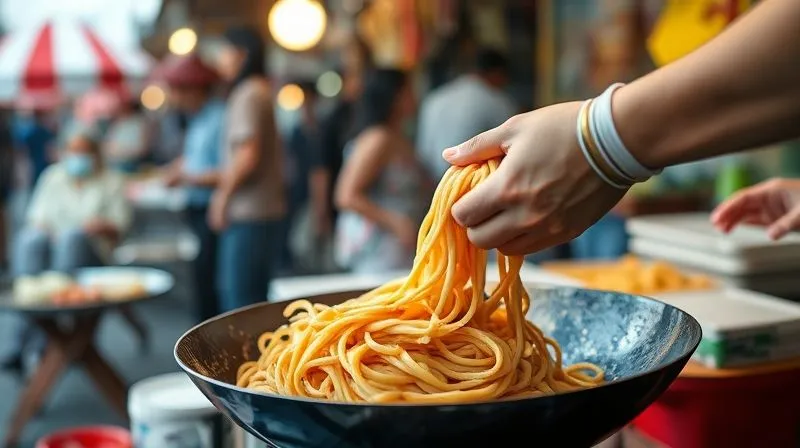
- Hands-On: Close-ups of skilled hands chopping, stirring, or plating can convey craftsmanship and tradition.
- Subtle Presence: Sometimes, just a blurred figure in the background is enough to provide context without distracting from the food.
The Environment: Setting the Scene
The surroundings of a street food stall are as much a part of the story as the food itself. They provide context, atmosphere, and a sense of place.
Consider wide shots that show the stall, the street, the architecture, and the general vibe. Then, zoom in for tighter shots of the dish, creating a visual journey for the viewer.
The Process: From Raw to Ready
For dishes that are challenging in their final form, consider capturing stages of their creation. The vibrant raw ingredients, the cooking process (flames, steam, sizzle), or the assembly can be incredibly photogenic and explain the complexity of the dish.
Post-Processing: Enhancing, Not Altering
Post-processing is a powerful tool, but for authentic street food photography, it should be used judiciously. The goal is to enhance the natural beauty and correct technical imperfections, not to create an artificial reality.
Essential Adjustments: Color, Contrast, Sharpness
- White Balance: Correcting the white balance is crucial, especially in mixed lighting conditions, to ensure colors are true to life.
- Exposure and Contrast: Adjust exposure to bring out details in shadows and highlights. Increase contrast subtly to give the image more punch, but avoid overdoing it, which can crush shadows or blow out highlights.
- Color Enhancement: Boost saturation and vibrance slightly, particularly for challenging dishes that might appear dull. Target specific colors (e.g., green herbs, red chilis) rather than a global adjustment.
- Sharpening: Apply a touch of sharpening to make textures pop, especially on ingredients like crispy fried bits or fresh vegetables.
Maintaining Authenticity
Avoid heavy filters or drastic color shifts. The aim is for a natural, vibrant look that reflects the reality of the dish and its environment. As ethical guidelines in photography often emphasize, the viewer should feel they are seeing a true representation, albeit one expertly captured and refined.
Gear Up Smart: Practical Tools for the Urban Explorer
While skill and vision are paramount, having the right tools can make a significant difference, especially in challenging street environments. You don't need the most expensive kit, but a thoughtful selection can empower you.
Camera Bodies and Lenses: Versatility is Key
I always recommend a versatile setup that can handle various lighting conditions and focal lengths.
- Full-Frame DSLR or Mirrorless: These cameras perform better in low light and offer superior image quality.
- Fast Prime Lens (50mm or 85mm): An f/1.8 or f/1.4 prime lens is invaluable for low-light situations and creating beautiful bokeh. The 50mm is often called the 'nifty fifty' for its versatility.
- Macro Lens (Optional but Recommended): For close-ups of textures and intricate details, a macro lens can elevate your shots.
- Zoom Lens (24-70mm f/2.8 or similar): A versatile zoom allows you to capture wider environmental shots and tighter food shots without changing lenses frequently, which is crucial in dusty or busy environments.
Portable Lighting and Reflectors
As discussed, these are game-changers for street food photography.
- Compact LED Panel: Look for one with adjustable brightness and color temperature.
- Small Collapsible Reflector/Diffuser: Essential for bouncing light or softening harsh light.
Essential Accessories
- Extra Batteries and Memory Cards: You never want to run out of power or space in the middle of a great moment.
- Cleaning Kit: A blower brush and lens cloth are vital for keeping your gear clean in dusty street environments.
- Lightweight Tripod/Monopod (Optional): For very low light or if you want to capture motion blur, but often impractical on crowded streets.
As National Geographic photographers often attest, the best gear is the one you know how to use instinctively and that fits your travel style.
| Category | Recommendation | Why it's essential |
|---|---|---|
| Camera Body | Full-Frame Mirrorless/DSLR | Superior low-light performance, image quality |
| Primary Lens | 50mm f/1.8 (or f/1.4) | Excellent for low light, beautiful bokeh, compact |
| Versatile Lens | 24-70mm f/2.8 | Covers wide to medium telephoto, constant aperture |
| Lighting | Compact LED Panel + Diffuser | Fills shadows, adds highlights in challenging light |
| Accessory | Collapsible Reflector (small) | Bounces light, softens shadows |
| Storage | Extra Batteries & Memory Cards | Ensures continuous shooting, no missed shots |
Navigating Ethical and Cultural Sensitivities
As a travel photographer, you are a guest in someone else's culture. Approaching street food photography with respect and sensitivity is not just good practice; it's essential for building trust and capturing genuine moments.
Respecting Locals and Customs
Before you even raise your camera, take a moment to observe. Understand the local customs, especially around food. Is it appropriate to photograph people eating? Is there a specific way the food is consumed that should be highlighted?
Permission and Etiquette
Always ask for permission before photographing vendors, their stalls, or their food, especially if you're getting close. A simple smile and a gesture, or learning a few local phrases ('Can I take a photo?'), goes a long way. Be prepared for a 'no' and respect it. Offering to buy the food you're photographing is a great way to show appreciation and often opens doors to more candid shots.
The best images come from genuine connection and mutual respect. Never treat people or their food as mere subjects for your lens; they are the heart of the story you're trying to tell.
Frequently Asked Questions (FAQ)
How do I deal with rapidly cooling food or melting dishes, especially for travel publications? This is a common challenge. Speed is key. Have your camera settings ready before the food arrives. Work quickly to get your primary shots (e.g., hero shot, texture shot) within the first 30-60 seconds. For dishes that cool quickly and lose steam, capture the steam immediately. For melting dishes like ice cream, focus on getting dynamic, quick shots that emphasize the melting process as part of its authenticity rather than trying to stop it. Sometimes, a slight melt adds to the visual story of a hot day.
What if the street food stall is in a very dark alley with almost no light? This is where your portable LED panel becomes indispensable. Use it with a diffuser to create soft, directional light. If you don't have one, look for any ambient light source – a distant streetlamp, a shop window, or even light from a nearby phone screen (subtly used). Increase your camera's ISO, but be mindful of noise. A fast prime lens (f/1.8 or wider) is crucial here. Embrace the darkness as part of the atmosphere, but ensure your food still has enough light to stand out.
How do I capture the 'smell' or 'taste' of food visually? This is the art of suggestion! Visually, you can convey smell through steam, smoke, or a vendor actively stirring a fragrant pot. For taste, focus on textures (crispy, gooey, juicy), glistening sauces, vibrant spices, and garnishes that hint at flavor profiles (e.g., a squeeze of lime, a sprinkle of chili flakes). Close-ups can emphasize these elements. Also, capturing people's reactions – eyes widening in delight, a satisfied smile – can powerfully convey taste without showing it directly.
Is it okay to move dishes around for a better shot in a busy environment? Generally, no. In a busy street environment, it's best to work with the scene as it is. Moving dishes can disrupt the vendor's flow, inconvenience other customers, and make your shot look artificial. Instead, adjust your position, angle, and camera settings. If a minor, non-disruptive adjustment is absolutely necessary (e.g., moving a fork slightly), ask permission first. Authenticity is paramount, and disrupting the natural flow detracts from it.
How can I make a simple, brown, or monochromatic dish look appealing? Focus on texture, light, and context. For texture, use side lighting or backlight to highlight any subtle variations in the dish's surface. A shallow depth of field can blur the background, making the dish stand out. Add a pop of contrasting color with a natural garnish (e.g., a lime wedge, fresh herbs, a chili). Include the human element – the vendor's hands, a customer enjoying it – to add warmth and story. The steam from a hot dish can also add visual interest and life.
Key Takeaways and Final Thoughts
Mastering the art of visually elevating challenging street food for travel publications isn't about transforming it into something it's not. It's about revealing its inherent beauty, its story, and its cultural significance through thoughtful photography.
- Embrace the 'Ugly Delicious': Understand that true beauty lies beyond conventional aesthetics.
- Master Light: Utilize natural light creatively and subtly enhance with portable artificial light.
- Compose with Purpose: Use compositional rules to bring order to chaos and highlight your subject.
- Un-Style for Authenticity: Make subtle, natural adjustments that enhance, not alter, the dish.
- Tell a Story: Integrate human elements, environment, and process to create compelling narratives.
- Process Ethically: Enhance images in post-production without sacrificing authenticity.
- Gear Smart: Choose versatile tools that empower you in dynamic street environments.
- Be Respectful: Always prioritize cultural sensitivity and seek permission.
Your camera isn't just a device for capturing images; it's a tool for storytelling, a bridge between cultures, and a means to share the authentic, delicious heart of a destination. Go forth, explore, connect, and let your lens reveal the extraordinary beauty in every challenging, wonderful street food dish you encounter. The world is waiting to see these stories through your unique perspective.
Recommended Reading
- The Ultimate Guide to Keeping Teenagers Entertained on Family Cruises
- Why HSR Budgets Soar: 7 Reasons & How to Control Costs
- 5 Secrets: Sustain High-Quality Free Walking Tours on a Shoestring
- 7 Proven Strategies: Mitigating Extreme Risks in Remote Wilderness Tours
- Volunteer for Sea Turtles: Your Ultimate Guide to Conservation

Your email address will not be published. Required fields are marked *